
FireflyWatch


© 6th Happiness (via Wikimedia Commons)

Last summer I spent a glorious week in Boyds Mills, PA. Among the memories I brought back from that week was this curiousity: firefly activity there was much higher than in my own backyard. Are there more fireflies in Pennsylvania? Are they more active? Did I simply sit and watch for fireflies more there than I normally do at home? Are fireflies in my own backyard on the decline? Happily, I now have an opportunity to examine these questions more carefully …

FireflyWatch is a citizen science project hosted by Boston’s Museum of Science. Its goal is to help scientists “learn about the geographic distribution of fireflies and their activity during the summer season,” and anyone can participate. You’ll find more information at the FireflyWatch website.

As some of you know, I am working on a book about citizen science. The number of organized and easy-to-use citizen science projects I have found over the past year has been staggering; I plan to continue introducing them here, because I will never, ever fit all of them in my book. Please help me spread the word by sending teachers and others who might be interested in these activities here. A click on the citizen science tag will bring up a handy page with all the relative entries.

Happy exploring!

var sc_project=2412924;
var sc_invisible=0;
var sc_partition=22;
var sc_security=”40523864″;

web metrics

From My Travel Journal …

I’m still transcribing my journal pages from Mexico. This entry is from our last full day in Mexico, when we visited El Rosario, the most well-known of the monarch sanctuaries. At each sanctuary visitors are required to pay an entrance fee, and this fee includes the services of a local guide. At El Rosario, our guide was a lovely Mexican man named Sylvester, who accompanied us up the mountain and answered our many questions.


© Ellen Harasimowicz

“Up ahead we walked along the roped area and discovered an unusual puddling scene: rivulets of water meandered downhill through the grass and hundreds of monarchs puddled in the sun. It was so unexpected, so peaceful. Just ahead the trail turned uphill; it ended shortly after at a line of rope. Beyond the rope we could see large clusters of monarchs on shaded fir trees. As we looked longingly over the rope at those clusters, hoping Sylvester would take pity and let us closer, we looked up and saw a decent-sized cluster directly over our heads. We settled in to wait for the sun to hit this amazing find.”

When the sun finally reached our cluster, Ellen began shooting madly. After having watched her photograph for several days, I knew she would be a while. I hung around for a bit and watched her work, but eventually I was tempted back down the trail…

“After an hour or more, I set out for the puddle alone to wait for Ellen. There were many more people on the mountain now (too many, actually) … and THOUSANDS of puddling monarchs. Thousands! I had to just sit and watch. These were the most remarkable moments of the trip for me — thousands of monarchs drinking at my feet and thousands more flying over and around me. They were happy, full-up sort of moments, contentment in a whirligig of orange and black. The people around me spoke in whispers and stood in awe of the spectacle; I sat and soaked it all in.”

var sc_project=2412924;
var sc_invisible=0;
var sc_partition=22;
var sc_security=”40523864″;

web metrics

From My Travel Journal …

This weekend I am reliving my six days at the butterfly sanctuaries in Mexico by transcribing my travel notes. I thought I’d share some of the entertaining bits here. This entry is from the first day, when we visited Cerro Pelon, a monarch sanctuary just outside the town of Zitácuaro in the state of Michoacán. Thankfully, Ellen’s photographs of me on horseback are not edited yet …


© Ellen Harasimowicz

“The path up Cerro Pelon was rocky, dry, and very dusty. My horse and I were lucky enough to be in the front a lot of the way, which saved me from the worst of it. My ‘caballo loco’, however, insisted upon taking the steep and rocky terrain at a run. I eventually learned a “smooch” sound told him to “GO!” and a yank on the red rope/bridle thingy told him to “STOP!”, but before I did there were some scary moments…

We saw a smattering of butterflies on the way up. As we neared the top, though, about an hour after setting out, the numbers swelled and the butterflies were everywhere. They were stunning against the blue sky …”


The Great Sunflower Project


© Loree Griffin Burns

Attention Citizen Scientists!

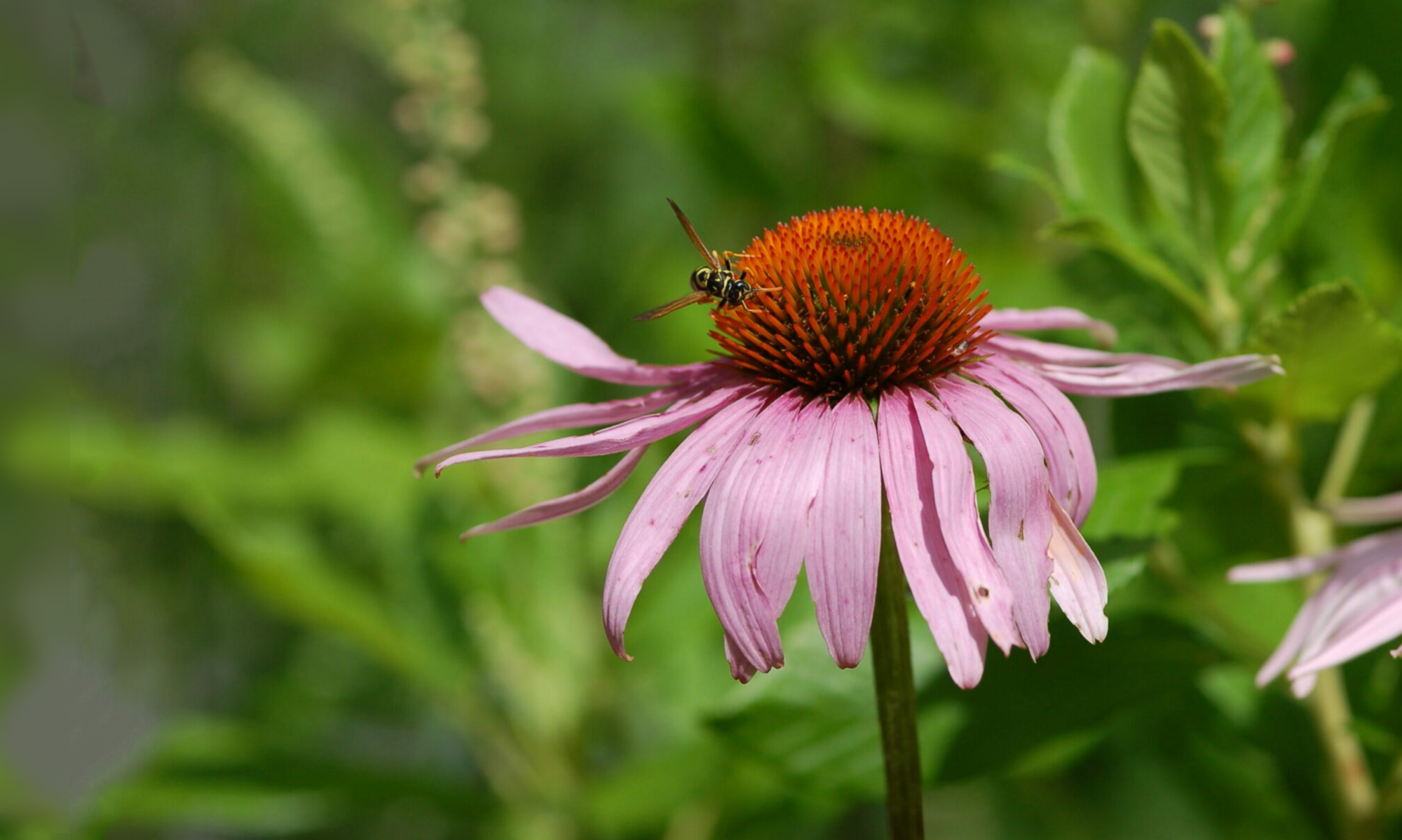
The Great Sunflower Project, an initiative designed to help scientists understand local pollinator populations by recruiting bee-spotters across the country, gets underway this month. In order to participate, you must be willing to plant sunflower seeds (provided), tend them, and once they bloom, watch them. Yep, watch them. Twice a month, participants are asked to observe their sunflowers and record how long it takes for five bees to arrive.

In the words of Gretchen LeBuhn, professor at San Francisco State University and director of The Great Sunflower Project, “We know very little about bee activity in home and community gardens and their surrounding environments, but we are certain that they are a crucial link in the survival of native habitats and local produce, not to mention our beautiful urban gardens. Our local pollinator populations require our understanding & protection, and to answer that call we need to determine where and when they are at work.”

The Great Sunflower Project website has loads more information on the project and how to participate. Check it out, and spread the word!


Change Has Come

Tomorrow marks the beginning of my Grand Mexican Adventure. I couldn’t leave without a small goodbye book tip, though, so here you go:

CHANGE HAS COME, An Artist Celebrates Our American Spirit
The drawings of Kadir Nelson
With the words of Barack Obama

Kadir Nelson’s pen and ink drawings are paired with lines from various speeches Barack Obama gave during the recent Presidential campaign. The combination is a stirring reminder of the Obama message, and it was a perfect book for this somewhat overwhelming week. (Overwhelming personally, as I prepare for my trip, and overwhelming generally, as our new administration begins the difficult work of moving the country forward.)

Treat yourself to a nice cup of tea and a look at CHANGE HAS COME this week; think of me when you do. I’ll see you all in about a week…


Butterflies, Butterflies, Butterflies

Butterflies are on my mind this week…

There’s this lovely quote from poet Rabindranath Tagore:

“The butterfly counts not the months but moments, and has time enough.”

And the gorgeous book I found it in:

FLYING FLOWERS
By Rick Sammon
Welcome Books, 2004

And a vacation week day-trip here to see these:

And preparations for a grand adventure here to see millions of these:


© Ellen Harasimowicz

I’ve even been writing about these:

(Any guesses what they are?)


2009 Great Backyard Bird Count


© Scott Weins, Eastern Screech Owl

No, we didn’t see any Eastern Screech Owls in our Great Backyard Bird Count (GBBC) on Saturday. But my beginning birders and I did see:

2 Red-bellied Woodpeckers
1 Downy Woodpecker
1 Hairy Woodpecker
4 Blue Jays
2 American Crows
3 Black-capped Chickadees
3 Tufted Titmice
1 White-breasted Nuthatch
4 American Robin
1 Northern Cardinal
1 House Finch
5 American Goldfinch

It was a glorious morning of sunshine, melting snow, and hands-on science. Ours was one of over 54,000 GBBC checklists submitted so far; you can find more 2009 GBBC stats and results here.

Hooray for citizen science!


The Truro Bear and Other Adventures

I have been without internet access since Monday. Initially I stomped and grumped and whined. But a funny thing happened midweek: while trying to distract myself, I slipped deeply into a WIP. Very deeply. It felt so good. And as my working hours acquired a steady beat, I warmed to unplugged life. What a fine, unencumbered and productive feeling it is to work without the pull of the world wide web! Now that reconnection is imminent (if you are reading this, I am back online), I am searching for ways to reinforce this beautiful (and productive) rhythm I’ve found. What luck to have had this book on my nightstand:

THE TRURO BEAR AND OTHER ADVENTURES
By Mary Oliver
Beacon Press, 2008

I basked in Mary Oliver’s poems and essays as I learned to bask in the quiet these past few days. To me, this is a book about slowing down, about taking the time to see, about encountering awe in every cobweb, embracing it with your eyes and ears and mouth, with your hands and your head and your heart. My favorite entry is an essay called “Swoon”, which starts this way:

“In a corner of the stairwell of this rented house a most astonishing adventure is going on.”

And, oh yes!, it is astonishing. I am reminded of my friends Jean-Henri Fabre (who is quoted, to my delight, in the frontispiece of this volume) and Sue Hubbell. I am reminded, again, that in order to see incredible things one must look. Only look.

Here’s to looking and to embracing the quiet … in spite of the internet.


Focus on Feeders

After the kids left on Saturday, I spent some time outside laying in the snow near the feeder, camera in hand. That’s when I saw the little fellow in the photo above, a pine siskin; another first for my backyard! Incredible what you will SEE when you actually take a minute to LOOK.

Anyway, I thought I’d share the Focus on Feeder report data that I am about to submit to MassAudubon. All told, we saw fourteen species of birds over the weekend:

4 American Goldfinch
6 Black-capped chicadees
2 Blue Jays
1 Carolina Wren
5 Dark-eyed Juncos
2 Downy Woodpeckers
2 Hairy Woodpeckers
6 House Finches
14 Mourning Doves
2 Northern Cardinals
2 Pine Siskins
1 Red-bellied Woodpecker
2 Tufted Titmice
4 White-breasted nuthatches

Not bad for one backyard!

If all this bird talk and citizen science talk has got your juices flowing, visit the Great Backyard Bird Count webpage to learn how you can conduct a bird census of your own this weekend, February 13-16, 2009. We Burnses are in, which is why I am off to fill my feeders again …